
What is Titania?
Datacenter-class inference, in the racks you already own
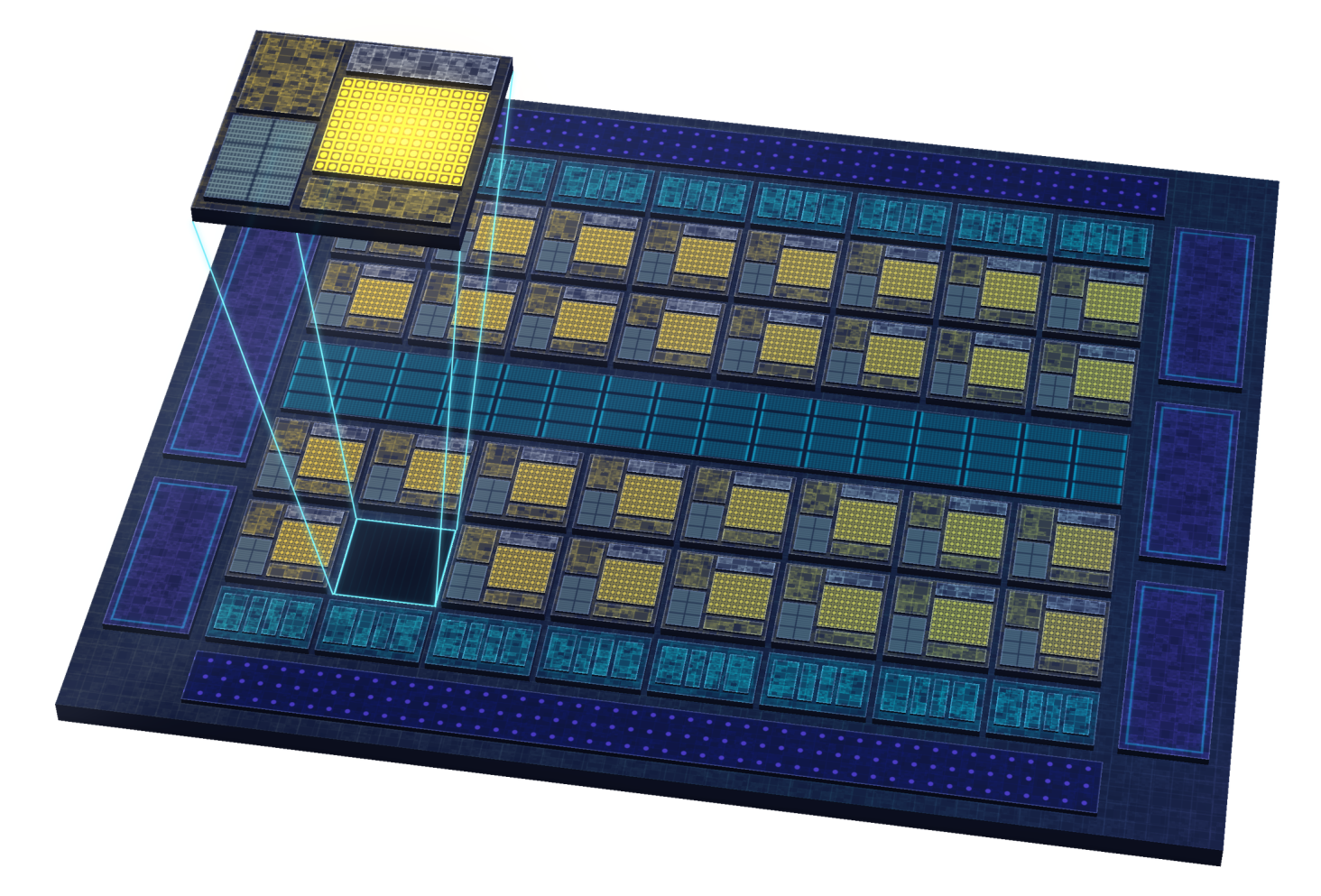
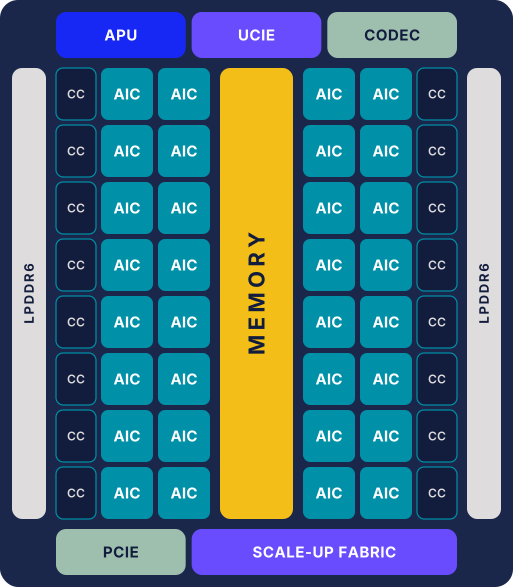
Titania is the third generation of an architecture already proven on silicon. Two chiplets. 2.5 petaflops. 128 GB of LPDDR6. 400 watts. Together they make one package built for the models enterprises actually run: LLMs, mixture-of-experts, agents, vision-language models and video.
Each chiplet pairs 32 independently programmable AI cores with 32 RISC-V compute cores and 128 MB of shared SRAM, so Titania keeps pace with new model architectures instead of being locked to today’s. It supports MXFP4, FP4, MXFP8, FP8 and BF16 natively. On-chip 8K decode and 4K encode take video off the host CPU, so language, speech and vision run side by side on one system.
Eight Titania packages fit in one air-cooled 4U server with 1 TB of memory, enough to hold a 1.6-trillion-parameter model. Titania will ship as PCIe cards and OCP-compliant OAM modules, air- or liquid-cooled, from a single server to the AI factory. It runs on the same Voyager SDK customers use on Metis and Europa today.

Enterprise Datacenter
Run LLMs, agents and RAG on your own data, in the air-cooled racks you already have.

HPC
Add datacenter-class inference to supercomputing and research centres without a liquid-cooling rebuild.

AI Factory
Serve sparse Mixture-of-Experts models at scale, holding per-user speed as demand grows.
Two Titania Chiplets, One SiP
|
|
|
3rd-Generation D-IMC Architecture |
|
||
| 64 AI-Cores across 2 chiplets | 2.5 PFLOPS FP8 per SiP at 400 W | ||||
|
|
|
32 RISC-V Compute Cores |
|
||
| Hide collectives across chips | Free the host CPU for business logic | ||||
|
|
|
LPDDR6 Memory Hierarchy |
|
||
| 128 GB at 2,458 GB/s per SiP | Keeps memory busy from batch 1 to large batch | ||||
|
|
|
Server-Scale Capacity |
|
||
| 1 TB LPDDR6 in an air-cooled 4U | Holds a 1.6T-parameter MoE model at FP4 | ||||
|
|
|
On-Chip Video |
|
||
| AV1 / H.265 encode and decode | No host-CPU tax in video pipelines | ||||
|
|
|
Built for Modern Models |
|
||
| Optimized for sparse Mixture-of-Experts | MXFP4 and MXFP8 support | ||||





E4 Computer Engineering is widely renown as being leader on integrating the latest technology solutions. We are testing Metis from Axelera AI and are very impressed with its capabilities as well as of the support provided by the Voyager SDK. We firmly believe that the next solution, Europa, offers a leap in performance such that data centers will more efficiently support the needs of their customers and we are prepared to integrate this new solution into our ecosystem!

At SURF, we empower researchers with world-class digital services and drive innovation through collaboration. Our partnership with Axelera AI, using Metis in SURF’s Experimental Technologies Platform and exploring Europa, reflects our excitement for emerging AI technologies that have the potential to transform research.

Our Edge plan has always gone beyond low latency: it's about enabling a new generation of applications that were simply not feasible before. Physical AI and robotics represent the most demanding and high-impact applications of all. We are combining our network, our edge nodes, and our European reach with silicon that can handle the most demanding AI workloads at the edge.

One SDK. Every Platform.
Deploy your AI applications across both Metis, Europa and Titania with the same Voyager SDK. Develop once and scale across the entire Axelera platform, from compact edge devices to enterprise servers. The Voyager SDK uses simple YAML configuration to automatically compile, optimize, and deploy your complete application pipeline, whether you're running vision models, image processing, or language models. Build on one platform, deploy anywhere your applications need to run.
