

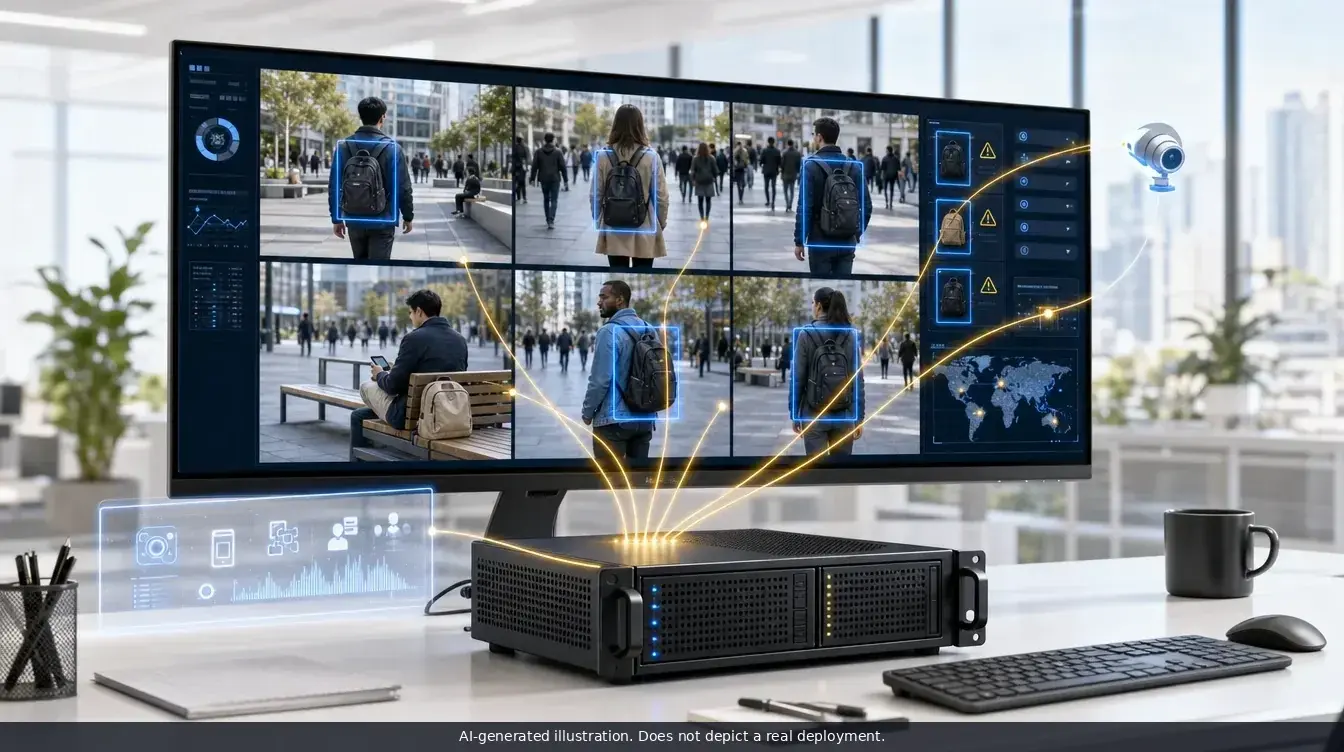
At the Global Security Exchange conference (GSX), BCD, a video infrastructure company delivering high-performance, reliable, and scalable storage solutions for physical security environments worldwide and Axelera partner, shared something security teams have wanted for a long time: AI analytics running locally, on the same box as the video. Engineered by BCD and powered by Axelera AI's Metis AIPU, the all-in-one appliance combines video recording, storage, PoE connectivity, and AI analytics in a single edge solution.
The demo ran on three camera streams, flagging people carrying backpacks for operators to keep an eye on. A crowd is full of backpacks, so the point wasn't to alarm on everyone. It was to give operators a headstart on the people worth watching.
Behind the demo is the integration that carries those detections into Milestone XProtect®. Axelera AI video analytics for XProtect is a verified Milestone integration, and Axelera AI is now a Verified partner in the Milestone Technology Partner Program.
Alarms in the list your operators already work from
When the analytics see something that matters, the integration opens a standard alarm in XProtect. Operators handle it in Smart Client exactly as they handle any other alarm. Each alarm carries what an operator needs to act:
- The camera - The operator steps straight from the alarm to that camera's recorded video.
- The person's position - The bounding box is given as a fraction of the frame, so it locates the person in the recording at any recording resolution.
- Confidence score - The model's own score for the detection.
- Tracking identity - It stays the same on every alarm raised for that person while they remain in view.
Each alarm opens the moment its trigger happens, not after the person has left. It closes on its own when they walk out of view.
Two kinds of alarms: one the model decides, one the operator decides
An alarm for every backpack is an alarm nobody reviews. So an alarm opens only when a rule the site has set fires, or when an operator marks a person. The two most used are below.
- Threat alarms: These fire automatically when a tracked person is carrying an object of a class the site has ranked as a threat. Which classes count as threats is a site policy decision, not something hard-coded.
- Person-of-interest alarms: These start with a human judgment. An operator watching the video wall marks a person, such as one of those backpack carriers, and an alarm opens in XProtect at once. That decision becomes a record in the VMS that anyone on the team can investigate.
The two read differently in the alarm list, so operators can tell them apart without opening them.
A clean picture, and a better one as the person moves
Each alarm includes a picture of the person, cropped from the camera's full-resolution stream. It is clean, with no overlay drawn on it, and is flagged that way, so it is the one to use as evidence. The picture keeps improving while the person is in view. The system scores face angle, size in frame, sharpness and lighting, and adds a visibly better shot to the open alarm, up to three times.
Detect at full resolution, record at whatever your storage allows
Cameras have moved to 4K and beyond, but recording budgets haven't kept pace. Many sites record high-resolution images and videos at a fraction of what the camera produces.
With this integration, detection runs on the camera's native stream, while XProtect records at whatever resolution the site chooses. The evidence picture comes from the native stream, not the recording. A site can record at 1080p and still have a full-resolution picture of every person who triggered an alarm.
Nothing to rip out
Cameras stream to the Axelera analytics and to XProtect in parallel, so the recording server takes on no extra load. Your cameras, recordings and views stay exactly as they are.
The integration talks to XProtect over a single outbound HTTPS connection to the API Gateway. It signs in with a dedicated account that holds only the four permissions it needs, never an administrator role.
The analytics can run on a dedicated host or, as BCD showed at GSX, on the same appliance as the video. We're working with BCD on what comes next.
See more about the Milestone and Axelera solution here.