Florian Zaruba | Technical CPU Lead at AXELERA AI RISC-V is inevitable – it became the mantra of RISC-V, and it’s true. But before we see why that is, let’s step back and discuss what RISC-V is and...
If you've talked to us in the last year, you already know our technology by the name that matters most: Axelera®. That's the name the industry uses, the name our customers reference in their design reviews and RFPs, and the name we're proud to put on every board that leaves our doors. Today we're bringing our product names into line with how the market already thinks about us, and, more importantly, into line with how our customers actually make decisions.
Here's what's changing, why, and what it means for the products you may already be running.
First: The products and product strategy are not changing; it is just the names.
From day one, our engineering approach has followed a single, deliberate arc. We built an architecture that is exceptionally optimized for the hardest environment in AI compute: the embedded edge, where power, thermals, cost, and footprint leave almost no room for waste. Get the architecture right there, and you have something with real headroom to scale into any environment.
So that's exactly what we did. We took that highly optimized embedded architecture and scaled it up — into edge appliances and gateways, robots and battery-powered physical AI, and into server-class inference solutions. The same efficiency DNA, deployed across a wider set of workloads. Embedded first, then edge, then server. That progression has always been the plan.
What hadn't kept pace was what we called these products. Our products carried names that were chosen at different moments for different reasons, and while each made sense on its own, together they didn't tell you the one thing you most want to know at a glance: where was this board optimized to shine?
What's already in your hands
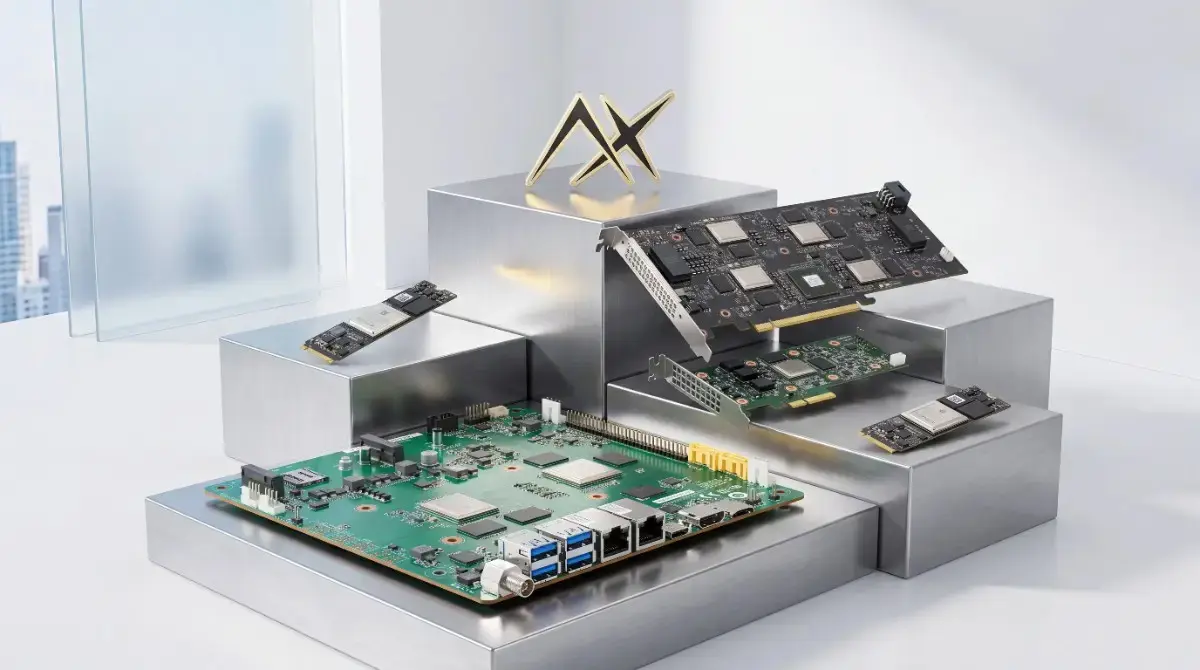
To reiterate: this is a naming update, not a product change. Every product built on our Metis® architecture is already in market and already selling into its respective segment. If you're evaluating or deploying an Axelera board today, nothing about the silicon, the performance, the software, or your roadmap shifts because of this announcement. The cards you know continue exactly as they are — they simply get clearer names.
How to read the new names
Going forward, every product carries the Axelera master brand, followed by an optimization descriptor and a short number.
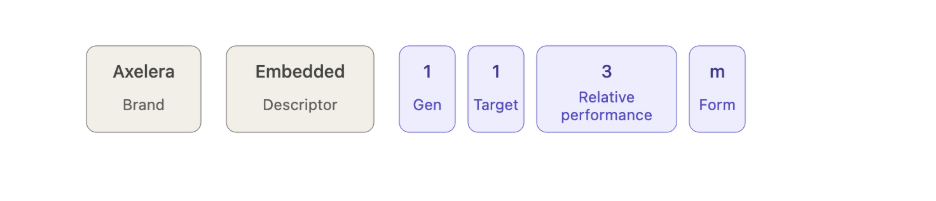
The descriptor is the fast answer to "where was this designed for?”
- Axelera Embedded — optimized for embedded and space-constrained designs
- Axelera Edge — optimized for edge systems and appliances
- Axelera Server — optimized for server deployments
- The first digit tells you the silicon generation or architecture. 1 for Metis or 2 for Europa®, etc.
- The second digit mirrors the optimization target named in the descriptor, so even if the name is shortened, it still says what the board was tuned for.
- The third digit helps distinguish amongst relative performance, or the combined effect of chip compute and memory bandwidth.
- The trailing lower-case letter indicates the form factor. For example, “m” for M.2, “p” for PCIe, “c” for compute boards.
The number that follows gives you a little more precision at a glance.
You don't have to memorize any of it, the point is that the name now does the explaining, so customers and partners can look at a part and immediately understand what it's built for.
Old name to new name
Here's how today's products map to their new names:
|
Previous name |
New name |
|
Metis® M.2 |
Axelera® Embedded 110m |
|
Metis® Compute Board |
Axelera® Embedded 111c |
|
Metis® M.2 Max |
Axelera® Embedded 113m |
|
Metis® PCIe (1-chip) |
Axelera® Edge 130p |
|
Metis® PCIe (4-chip) |
Axelera® Server 150p |
"Optimized for" is purely a reference, utilize the cards where they work for you.
This is the part we most want our customers to hear. When we say a board is optimized for embedded, edge, or server, we're indicating where we tuned it to perform best, not necessarily where you are going to deploy it.
You know your workload, your system, and your business constraints better than anyone. If an Axelera Embedded card is the most efficient, most cost-effective way to solve a problem inside a server chassis, use it there. If an Axelera Edge board is the right fit for something we'd have called an embedded application, that's your call to make. The new names are meant to shorten the distance between "what problem am I solving?" and "which board should I start with?"
What stays the same
A couple of things aren't going anywhere. The celestial names you may know — Metis, Europa, Titania, describe the underlying silicon architectures rather than individual products. They give our more technical audiences a precise way to talk about generational advancements while the Axelera product names speak to the systems and outcomes most buyers care about. And Voyager®, our software platform, continues unchanged.
Why this is good news
A clearer name is a small thing that removes a lot of friction. It means faster orientation for customers and partners, cleaner conversations across your teams, and a lineup that reflects the strategy we've been executing all along, one platform, optimized for the toughest constraints, scaled across embedded, edge, and server.
We're excited to carry a single, coherent Axelera name across everything we build, today and for every product still to come.
Thanks for building with us.
— Alexis & Manuel